
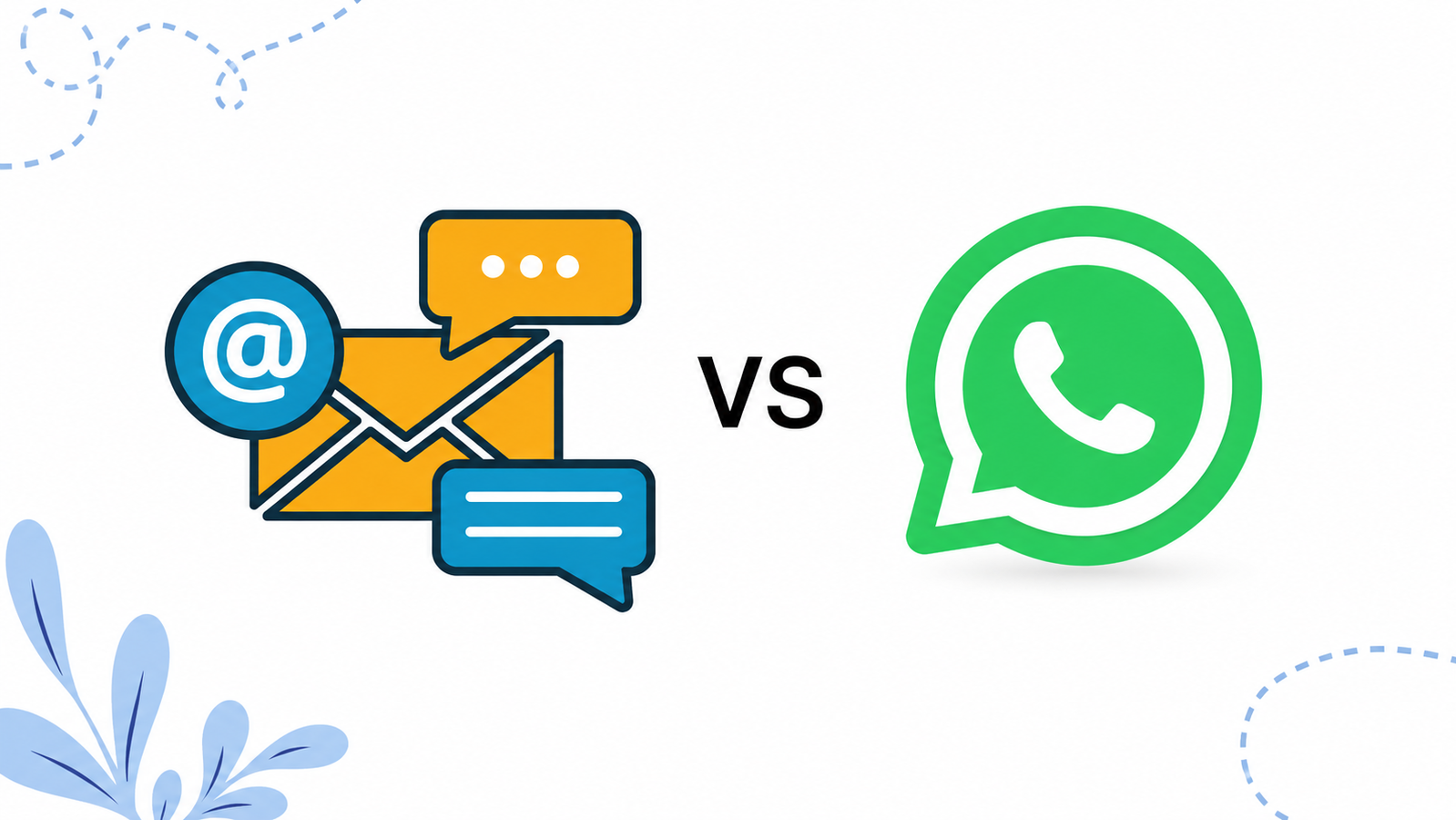
You have a wonderful product and a professional website and customers have expressed interest in your business. Getting to those customers is always a question. Would you send an e-mail or a WhatsApp message?
Many business owners tend to choose one channel without understanding how they work. Consequently, they either lose out on sales opportunities or they send messages to customers that go unanswered.
Choosing the right communication channel can improve client engagement, increase conversions, and build long term relationships. The good news is you don’t have to choose one or the other. Knowing when to use each one is where the real value lies.
Consider your own habits. You can disregard marketing emails on a hectic workday, but you will open a WhatsApp message from a firm you are expecting to hear from immediately.
At the same time, if you’re looking into a product, or comparing services, you’re more likely to read a long email than a short one. Businesses should be aware of this distinction so that they can interact naturally and not in an intrusive fashion.
In this article, you will learn the differences between email marketing and WhatsApp marketing, their pros and cons, when to use each of them, and how to use both to enhance your growth.
Table of Contents
What is email marketing?
Email marketing is when companies send emails to clients or subscribers to let them know about product offers, instructional information, or product suggestions. Businesses use it to keep in touch with their audience and slowly build trust.
A social media post might be missed in seconds, an email can remain in a customer’s inbox until it is opened or deleted.
Email allows firms to communicate in a lot of detail. Share your products, share your brand story, offer helpful tips and even automate messages based on user actions.
Why Email Is Still Essential for Business
- View emails when it suits them → Customers can view emails when it’s convenient.
- Customers can search emails → Customers can quickly find and search past emails.
- Business segments clients → Businesses can segment their customer to run targeted ads.
- Automation takes time → Email automation lowers manual work and saves time.
- Professional Communication → Consistent and professional branding.
Example :
A coaching institute communicates through email that includes welcome emails, study material, exam reminders, and certificates.
That would make WhatsApp messy.
Advantages :
- Perfect for detailed communication
- Develops longterm customer relationships.
- Great for newsletters and product releases
If your aim is to educate, nurture, and build trust with your audience, then email marketing is your best bet.
What Is WhatsApp Marketing?

WhatsApp marketing is a form of direct messaging to reach out to customers. It enables businesses to send order confirmations, product updates, limited time offers, reminders and customer assistance messages.
The vast majority of people check their WhatsApp several times a day thus they are likely to notice your messages far quicker than emails.
Why it’s important
WhatsApp is meant for personal instant communication. Customers can ask questions, respond immediately and make purchases without bouncing between multiple platforms.
Why customers reply faster on WhatsApp :
- Everyone looking at WhatsApp again and over
- Replies sound conversational
- Simpler than opening browser
- Customers trust chat interface they know
A real life example :
If someone builds a website on JoonWeb and doesn't publish it. Friendly WhatsApp reminder: "Your website is almost done. Publish it today and start reaching customers online” can tempt them to come back and complete the task.
Benefits :
- Very high message visibility
- Quick customer responses
- Good client service.
- Good for up to date news and reminders.
Use WhatsApp marketing when you need it, when you need speed, ease and personal communication.
Email Marketing vs. WhatsApp Marketing
Both channels are growth engines for businesses, but with different purposes.
|
Feature |
Email Marketing | WhatsApp Marketing |
|---|---|---|
| Best for | Detailed communication | Instant communication |
| Speed | Moderate | Immediate |
| Content | Articles, newsletters, product updates | Short messages, reminders, offers |
|
Customer interaction |
Slower | Quick conversations |
| Automation | Advanced | Growing rapidly |
| Relationship building | Excellent |
Excellent when used carefully |
Why this comparison is important
Rather than asking which channel is best, ask which channel is right for your goals.
If you’re starting a new service, email gives you plenty of room to explain everything.
WhatsApp is much more effective if you want to remind customers about a limited-time offer or an abandoned cart.
Pick the platform, depending on your objective, not popularity.
Email Marketing: When Should You Use It?

Email marketing is best when you have something that needs explaining.
Use email when you need to:
- Roll out a new product
- Share business news.
- Send e-newsletters
- Train the customers
- Develop trust over time.
- Product recommendation based on customer preference
Real-life example :
A clothing store that sends out monthly emails with new arrivals, fashion tips and exclusive member discounts. Customers receive good material, not endless sales pitches.
If you need to provide context, explain or tell a story in your communication, for that email is the preferable tool.
Whatsapp Marketing: When Should You Use It?
Whatsapp is mostly used for clients for quick information or urgent action.
Use whatsapp when you need to:
- Order acknowledgements
- Shipping Updates
- Reminder of appointment
- Flash sales customer support
- Cart collection
Real life example :
A bakery sends out a WhatsApp message : Today we have fresh chocolate cakes. Order before 4PM for same day delivery."
The customer can react immediately and order within minutes.
WhatsApp is usually the better option if timing is important.
Email or WhatsApp?
The buying decisions of your customers: Which one to pick?
Some businesses require a lot of detailed communication, and some businesses require fast personal conversations.
Companies can use e-mail to provide customers with time and information prior to purchase.
SaaS companies: Email is a fantastic distribution channel for a SaaS company to distribute product demos, feature updates, onboarding guides, and case studies. Most customers will look at different software products before signing up.
Education providers: An education provider could discuss courses, admissions, fees, schedules, and student success stories. Typically students and parents read everything carefully before signing up.
Consultants: Consultants can email proposals, service packages, reports, and meeting summaries. It creates a professional record that the client can refer to for decision-making.
Real estate companies: A real estate company can send brochures of properties, location maps, prices, financing options, and virtual tours of the property. Buyers are viewing many houses before they make such a big investment.
Finance businesses: Email is a powerful way to distribute investment reports, policy documents, account statements and significant updates where accuracy, documentation and trust are key.
WhatsApp is perfect for businesses who need to have quick chats and fast reaction times from customers.
Restaurants: Restaurants can broadcast daily promotions, holiday offerings, table availability, and order status to customers so they can make quick eating decisions.
Salons: Appointment confirmation, WhatsApp reminders for clients to stay connected, promotion of seasonal bundles and rapid answers to questions about services.
Local stores: Local stores can tell customers what’s new, limited-time discounts, product availability, and delivery updates right away that can encourage customers to buy right now.
Doctors and clinics: Doctors and clinics can confirm appointments and send prescription reminders, follow-up messages, and basic patient communication through WhatsApp, making healthcare more convenient.
Customer service for repair and home service businesses: Customer service for repair and home service businesses can be faster and more seamless with instant customer updates, quotations, technician arrival updates, and customer queries.
The best strategy is not to select one communication method over another. It’s about applying the channel that’s appropriate for the way your customers want to buy.
Can you use both simultaneously?

Yes, Most businesses prefer to use both email and WhatsApp instead of only one or the other.
For example :
JoonWeb customers download a free guide to websites.
They receive both a welcome email and a whatsapp message with helpful resources and tips for the site.
A few days later, they attract customers to your business, but it is your website that converts their interest, do WhatsApp messages reminding them to complete the setup of their website or have a look at the premium features.
The email builds Connection.
The WhatsApp message is a Call to action.
They work together to create a better customer experience.
Typical mistakes to avoid
The best marketing channels will not work if used the wrong way.
1. Mail sent too many times
Soon, clients lose interest if all the messages are promotional.
For example, posting a discount message on WhatsApp every day can cause the customer mute or block your business.
2. Same old stuff everywhere.
Email and WhatsApp message should not be same.
Email is preferable for detailed information.
WhatsApp is concise and gets straight to the point.
3. Ignoring customer consent
Only engage with clients who have opted-in for your messaging. This builds trust and boosts engagement.
4. Forgetting the destination
Whether they click on an email or a WhatsApp message, a customer should be directed to a quality website that loads quickly and clearly explains your products or services.
Conclusion
Email Marketing & WhatsApp Advertising and marketing are both powerful communications but they are not the same. The proper answer is dependent on your business objectives, your audience and the message you are trying to portray.
Email is a terrific tool to educate clients, give specialist knowledge, build confidence over time and develop long term connections. This is especially true for products and services with longer buying cycles, which allows buyers more time to research, assess and make an informed decision.
WhatsApp, by comparison, is meant to be quick and simple. Organisations may have real time conversations, respond to consumer complaints promptly, disseminate information swiftly and act immediately. If your business relies on appointments, orders, bookings, or local clients, WhatsApp can greatly enhance response rates and customer satisfaction.
The greatest businesses don’t see email and WhatsApp as competing channels. Instead, they put each where it is best. The email can promote the product with full details, while WhatsApp can remind the buyer of the deal or answer last-minute questions.
These contact channels, coupled with a fast, professional, and user-friendly website, facilitate a smooth consumer journey. Provide the right information to the right consumer at the right moment. And your customers will trust your brand more and be far more inclined to become loyal repeat buyers.
Technology evolves, but customers still love meaningful communication.Companies who respect their audience, deliver useful messaging and point them to a competent website are more likely to develop long-term relationships than companies that just send frequent ads.
REQUIRED ACTION
Marketing messages can get customers to your business, but it’s your website that gets interest to turn into action.
Whatever you do, whether email campaigns or WhatsApp campaigns, or both, make sure that every click takes you to a website that builds trust and drives conversions.
Develop your business website with JoonWeb, and give your marketing campaigns a destination that delivers.