
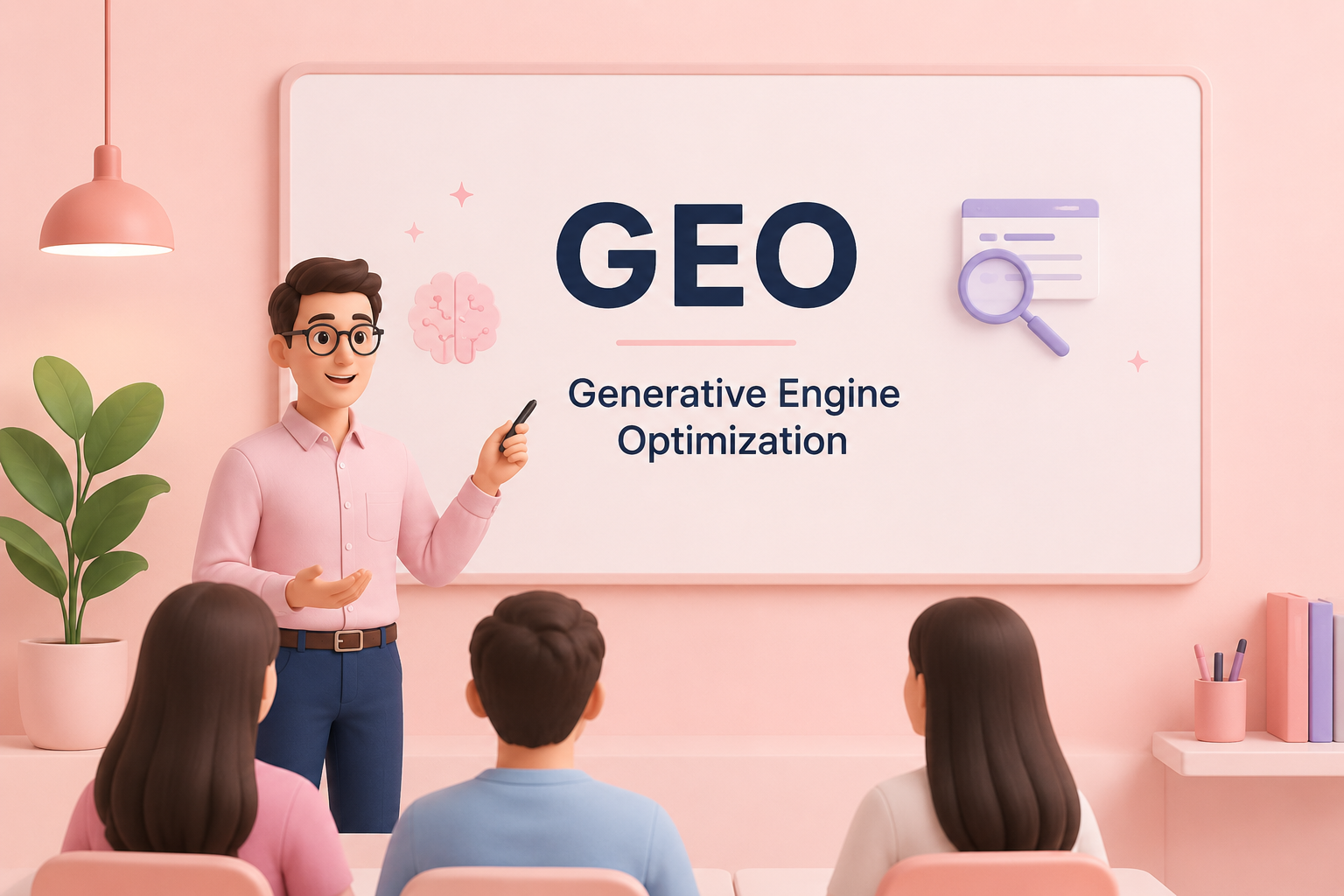
Generative engine optimisation is a method for making your information understandable and usable for AI models.
Search engine optimisation has been employed by businesses for over twenty years to enhance their presence on search engines such as Google. The idea was simple: get ranked higher on search engine results pages. Bring in More Visitors
But the way people get information is changing swiftly. Today billions of users are asking queries of AI assistants like ChatGPT, Google AI Overviews, Gemini, Claude and Perplexity instead of typing keywords into a traditional search engine.
Generative engine optimisation is the process of ensuring your material is clear enough, trustworthy enough and helpful enough for AI models to reference or cite in generating replies.
Generative engine optimisation – what is it?
Generative engine optimisation is the practice of optimising material so that AI-powered search engines and conversational assistants can readily understand, trust and use it to answer users’ requests. The goal of generative engine optimization is to boost the possibility that AI systems will quote, summarize or suggest your material in answer to questions.
For example, a user may ask, ‘Best AI website builder for businesses?’
Your job in generative engine optimisation is to provide well-structured content that an AI assistant will utilize your explanation to answer the user’s question.
You can’t truly grasp GEO unless you understand what is truly powering it and that is Large Language Models (LLMs).
These are the AI systems underpinning Amazon's AI system, Google Gemini, and many more. LLMs can read, understand and generate complete answers in normal, conversational language.
In the age of AI search with GEO & LLM, how are businesses changing?
The digital landscape leading to enterprises is changing quicker than ever.
Before, buyers would search on Google, evaluate different websites and then determine which business to trust. But now many people turn to AI-powered applications such as ChatGPT, Google Gemini and Perplexity to get fast recommendations instead of perusing multiple search results.
This transition is offering new opportunities for firms to expand. When an AI assistant suggests your product, service or website to answer a user’s question, your business will gain awareness and users will begin to trust your offerings.
This is where Generative Engine Optimisation (GEO) comes into its own. GEO helps companies produce material that AI tools can understand, trust and simply reference.
How GEO and LLM are connected?

Think of it this way.
Search engines used to work in a relatively straightforward way:
You type something → you receive a list of sites → you choose one.
But LLM-based search is another story:
So you ask a query now → and AI provides you a perfect response straightaway.
No extra work. No digging around links.
And while doing that it takes information from numerous sources and merges it into one answer.
So if your material is:
- well-formed lucidly
- actually useful
- simple to grasp
- easy to understand
The AI will likely use your content to generate its answer.
So why is this transition a huge thing for businesses???
Because this isn’t simply a tech industry update, it’s a total revolution in how customers find brands.
Previously, enterprises depended on the following:
- Google rank
- Ads
- Backlink
- SEO traffic
But now, people literally question AI about everything like:
- best skin care brand for sensitive skin 1
- best tools to create websites
- inexpensive fashion labels
So this is how your firm will be identified now.
AND THAT IS POTENT.
For example, a small business owner asks me, “Who can build an affordable business website?” So if your website contains GEO optimised material like JOONWEB then it will suggest you in its response.
How GEO actually helps businesses grow

1. Your brand is featured in AI produced responses.
With GEO, your brand lands straight in the AI-generated answers, so you get visibility without having to rely on typical search results and wasting hours on something.
2. It is more reliable.
AI responses are neutral. They don’t appear like ads at all.
When a user sees your brand mentioned in an AI response, it feels more like a recommendation than promotion.
3. Quicker buying choices
This is missed by most individuals.
By the time a user lands on your website from an AI search, they have already:
- understand what you're doing
- mentally compared possibilities
- have more trust in the suggestion
So they’re a lot closer to action.
Less believable. More conversions.
4. Small business really can compete.
AI doesn't care who's the biggest.
It is interested in:
- clarity
- usefulness
- relevance
- structure
So if a tiny brand can explain things better than huge brands, they may easily appear next to major firms.
That’s a major shift.
For Example : Instead of relying only on Google, websites like Joonweb is creating AI friendly content and digital resources that helps user a lot. Even in your business you can also use AI search and improve it’s visibility and trust.
Effects on different sectors:
How different industries are getting affected :
1. Food Industry
Here people usually ask for:
- healthy
- meal
- quick suggestions
top restaurants in my area
Fast recipes
If your restaurant or food blog contains content in a good structure, AI can propose it right away.
That implies greater discovery without the need to search.
2. Fashion Industry
We are no longer looking for just fashion brands. They pose questions to AI such as:
- What to wear to a wedding?
- Affordable Streetwear Fits?
- What to wear this season?
The more useful a brand’s style guide, outfit ideas and fashion tips, the more likely it will be suggested in AI-generated responses.
3. E-commerce
- People frequently ask:
- best phones on budget
- finest skin care products
- laptops for students on a budget
And AI compares it all for them.
So, if your product page is informative and easy to read, you can easily get recommended inside AI answers.
This is quite helpful for sales.
4. Technology/SaaS
People ask of software tools:
- Best project management software
- Top CRM software
- The Best AI Writing Tools
If your SaaS has good explanations of features then AI will definitely recommend it.
So…what is GEO really doing here?
If you make it all simple:
- It is LLMs that make the “decisions”.
- AI search is the new “search engine”
- GEO is the way you make your information clear to both
You want your material to be so clear that it’s just picked up by AI.
Advantages of Generative Engine Optimisation.
Generative engine optimisation lets you:
Discover yourself in AI Answers Your material can be directly featured in AI-generated replies, not just Google clicks.
Get trusted quicker. AI systems consuming your material repeatedly automatically builds confidence in your brand.
Better the user experience. Clear content = pleased users = time spent on your site.
Easily support your search engine optimisation. Good generative engine optimisation material is inherently useful and structured, thus it helps search engine optimisation also.
Typical errors in generative engine optimisation
That’s the way a lot of people still approach generative engine tuning and it sounds straightforward. So let's speak about some mistakes:
- Keyword optimization. Many people still think that repeating keywords will work. Now it just feels awkward and forced.
- Shallowing content. AI search doesn’t tend to work well on short items that don’t really go into any detail.
- Not respecting structure
- Long paragraphs without headings or breaks are difficult for both people and AI to process.
- Not updating material. As time passes, older information becomes less helpful in fast moving disciplines like AI.
- There is no value written. If the content does not genuinely assist the reader learn something, it is probably not going to get picked up by AI systems either.
In the end, generative engine optimization favors clarity over complexity.
The Future of Optimizing Generative Engines:

Search is evolving, silently. Very fast. We’re slowly moving away from typing keywords into Google and instead asking AI helpers queries. That affects all that. We will see more AI-driven search results of link lists in the future, more conversational replies rather than static pages, more tailored results based on user intent and less reliance on traditional keyword-heavy Search Engine Optimisation.